CW: fatphobia, eating disorders, IWL/diet talk
Introduction
“Nothing tastes as good as skinny feels”; this was the oft-repeated mantra of the doctor who once helped me lose over 30 pounds (after having already lost 40) in a little under three months by dramatically restricting my diet. Her words are symptomatic of a larger trend that is deeply entrenched in the medical industry, namely, an underexplored and oversimplified conflation of health and wellbeing with weight. The automatic attribution of poor health to body size has led to an emphasis on reducing body mass, often to the detriment of health. By identifying fatness as a problem in and of itself, the medical industry has made itself a complicit player in the size-ism and weightism that run rampant in U.S. and other developed societies, lending professional credibility to the “fatphobic” attacks of the diet, fitness, and fashion industries on fat individuals. Eating disorders, particularly anorexia nervosa and bulimia nervosa, are a logical consequence of this rampant weightism and size-ism, a natural response to the medically reinforced notion that thin = good and that fat must be avoided at all costs.
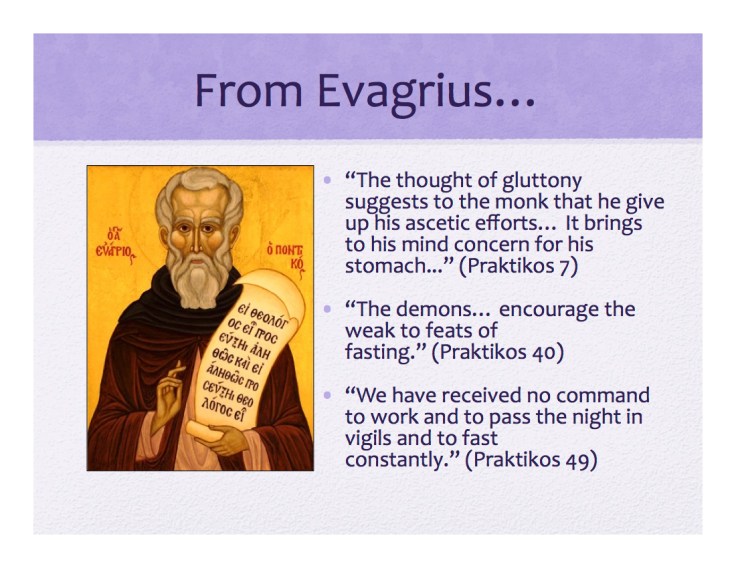
The church has resources that can help heal our society’s disordered and unhealthy relationship to both food and body. These resources date back to the early centuries of Christianity; in particular, this paper will explore the relevance of the writings of Evagrius Ponticus, a fourth century Egyptian desert monk, and Gregory the Great, a sixth century Roman pope. Both of these Christian figures wrote extensively about the ancient church’s understanding of gluttony, and about how the relationship between self, neighbor, creation, and God is properly to be understood. Two other key tools in the ecclesial toolkit are a theological affirmation of the inherent goodness of creation, and a robust theology of incarnation. Together, these resources present a countercultural and life-giving alternative to our eating disordered society that is deeply rooted in God’s love and promises. Continue reading “Waging Holy War with the DSM-5”


 St. Antony, also known as Anthony the Great, was a Christian monk who lived in Egypt in the third and fourth centuries. He renounced the wealth left to him by his parents and chose to live an ascetic life in the desert, fasting and meditating on Christ. Antony became a wise and famous figure of Egyptian monasticism, but more than anything, he was known for his battles with demons.
 Antony instructs his followers to be wary of these demonic voices, telling them that they fill one’s head with “filthy thoughts” and cause “apparitions,” that “they pretend to frighten us by changing their shapes and taking on the appearance of women, wild beasts, reptiles…” (Athanasius, 2003, p. 113)

 This is the Day