Sermon: You’re Killing Me, Smalls

Sunday, March 29, 2020
St. John’s Lutheran Church, Schuyler, NE
Fifth Sunday in Lent
watch this service online (gospel reading and sermon start around 16:53)

Even though our texts for this week are serious and heavy – dealing with life and death kinds of stories – weirdly enough, the one thing that kept coming to my mind all week was one of my favorite movies to watch when I was growing up: the 1993 cult classic The Sandlot.  

In the movie, a nerdy kid named Scotty Smalls moves to a new city with his parents.  He ends up making friends with a group of neighborhood boys who are all completely obsessed with baseball.  They all gather down at the sandlot to play baseball nearly every day.  The sandlot, as its name suggests, is a vacant, sandy lot that the boys have turned into their very own baseball diamond.  

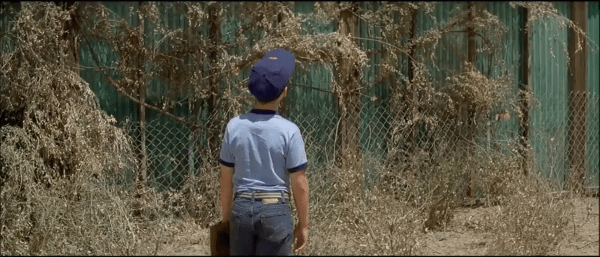
One of the important features of the sandlot is a fence.  Beyond their outfield, there is a tall, ragged fence – maybe 7 or 8 feet tall; it’s an impenetrable barrier cobbled together from rusted old junk and corrugated metal sheeting and lengths of chain link and it’s all grown over with vines and brambles.  It’s a gnarly-looking old fence, and all you can see beyond it is some overgrown trees and the top of an old, dusty house.

One day, one of the boys hits a baseball clean over the fence.  And to Scotty’s surpise, the other boys treat this hit like an automatic home run.  They don’t even try to go over the fence and get the ball back.  Scotty is already out in the outfield, so he yells to the other boys, “Wait a sec, I’ll get it!” and he starts to climb the fence.  In response, the other boys all scream, “NOOO!” and they all immediately run across the field to Scotty and physically drag him back down onto the ground.  Scotty is annoyed and confused by this, but the boys all hold him back, shouting in chorus, “What are you doing??  You could have been killed!”  

As Scotty learns, the boys all live in fear of a huge, mean, baseball-hoarding dog who lives on the other side of the fence, a dog whom they have nicknamed “the Beast.”  And so, anytime they hit a baseball over the fence, it’s considered gone for good.  To these boys, that outfield fence has become the point of no return.  Once you cross over that barrier, there’s no coming back.

Continue reading “Sermon: You’re Killing Me, Smalls”

Mary Stood Weeping

But Mary stood weeping outside the tomb. As she wept, she bent over to look into the tomb; and she saw two angels in white, sitting where the body of Jesus had been lying, one at the head and the other at the feet.  They said to her, “Woman, why are you weeping?” She said to them, “They have taken away my Lord, and I do not know where they have laid him.”  When she had said this, she turned around and saw Jesus standing there, but she did not know that it was Jesus.  Jesus said to her, “Woman, why are you weeping? Whom are you looking for?”

John 20:11-15a

Early on the morning of the very first Easter, Mary Magdalene stands, weeping, outside the empty tomb.  So much has happened – so much hopeful excitement, followed by so much sorrow, so much loss.  And now, when she has come to say her goodbyes to her friend, to her hope, it seems that the universe has added insult to injury and someone has taken his body, so that she cannot even mourn him properly.  

The worst thing imaginable had happened to Mary and the other followers of the Way – they had watched helplessly as the Roman Empire crucified their Messiah and Lord.  Their hopes for God’s reign were snuffed out.  

Yet God was not done.  

Continue reading “Mary Stood Weeping”

Sermon: A Shepherd Shall Lead Us

Wednesday, March 25, 2020
Funeral of Terry Pospisil
Svoboda North Chapel, Schuyler, NE
image source

When I was growing up, my best friends’ family had a farm just a few miles outside of our hometown.  And they raised sheep.  I spent a lot of time out at their farm, and sometimes I would get to help take care of the sheep.  There was, of course, the matter of making sure the sheep had water and enough to eat.  And, periodically, they would have to move the sheep from one pasture to another, to give them plenty of grass to munch on.  My friends’ parents would open gates and move around their electric fences.  And then we got to do the fun part: in the absence of sheepdogs, my friends and I would actually chase the sheep around, trying to get them to move from one enclosure to the other.  To me, at the time, it seemed like being a shepherd would be a really fun job!

But that is not at all what being a shepherd looked like thousands of years ago, when Psalm 23 was first written.  Back then, being a shepherd was a tough, dirty job.  There were no neatly fenced in pastures to keep their sheep in.  Instead, a shepherd wandered with his flock of sheep through the steep hills and rocky wilderness of ancient Palestine.  He stayed with his sheep night and day to protect them from predators.  And the sheep’s lives totally depended on their shepherd guiding them through rough places to find clean water and good pasture.  

That is the image of God that our psalmist is painting in Psalm 23.  God is like a good shepherd, willing to do anything to keep the sheep safe and fed.  And like a good shepherd who is willing to get his hands dirty, God stays with us, even in the hardest, messiest, most painful moments of our lives.  God is with us.  God never abandons us nor leaves us to our own devices; instead God wanders with us into the wilderness and helps guide us to places of safety and peace.

Continue reading “Sermon: A Shepherd Shall Lead Us”

Sermon: Compassion, Not Fear

Sunday, March 22, 2020
St. John’s Lutheran Church, Schuyler, NE
Fourth Sunday in Lent
watch this service online (gospel reading & sermon start around 18:01)
image source

I really struggle with a verse like John chapter 9, verse 4.  In this verse, Jesus responds to the disciples’ question about sin, saying, “Neither this man nor his parents sinned; he was born blind so that God’s works might be revealed in him.”  A statement like that one feels dangerous to me.  On its face, this verse kind of makes it sound like Jesus is saying that God deliberately chose to inflict suffering on someone – like God chose to make someone suffer simply because it would make Jesus look good later. 

There is a lot of toxic theology out there that follows this idea.  I’m sure you have probably heard some of it at some point in your life.  It’s the “everything happens for a reason” school of theology; it’s the kind of theology that teaches that even suffering comes from God – that if you are suffering, it’s either because you deserve it or because God is trying to teach you a lesson or to make an example out of you. 

But that’s not what I believe.  I don’t believe that suffering is ever part of God’s plan for us, because that simply does not square with the God of love and grace that I know and trust.  That’s not who God is.  The God I follow does not inflict suffering on people just to prove a point; instead God is present with people in their suffering, supporting them and loving them unconditionally.

So how do we make sense of what Jesus says here?  Jesus tells his disciples that this man was born blind so that God’s works might be revealed in him.  

Continue reading “Sermon: Compassion, Not Fear”

Virtual Church

This past week has marked a seismic shift for many of us in how we live our daily lives, and for those of us in ministry, it has meant drastic change in how we gather and connect as the body of Christ.

For anyone who might be looking for resources or some kind of spiritual grounding during this time, I thought I would post a link to the “Virtual Church” page I put together for my own congregation — St. John’s Lutheran Church in Schuyler, NE. On it, you will find updates and links to resources for prayer and meditation, as well as links to participate in our live-streamed worship and bible study.

May God’s peace be with you during these uncertain days.

Be safe, and wash your hands!

Sermon: Going Through Samaria

Sunday, March 15, 2020
St. John’s Lutheran Church, Schuyler, NE
Third Sunday in Lent

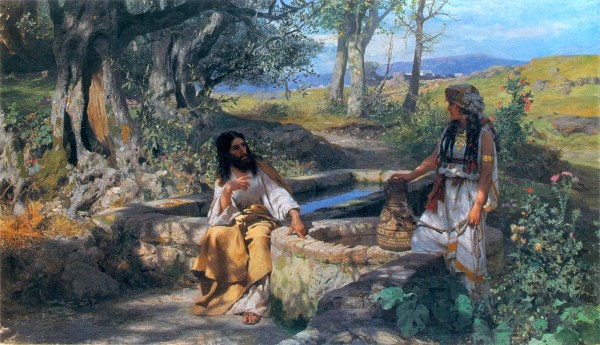
Our gospel text for this morning picks up just about half a chapter after our gospel reading from last week.  And there is a LOT going on here.  

Last week, you might remember, Jesus was in Jerusalem, where he received a nighttime visit from a Pharisee named Nicodemus.  In the first few verses of John chapter 4, Jesus learns that trouble might be brewing with the rest of the Pharisees, so he and his disciples decide to hit the road.  In verses 3 and 4 of chapter 4, John writes that “[Jesus] left Judea and started back to Galilee.  But he had to go through Samaria.”  And that is where our story begins.

John writes that Jesus “had” to go through Samaria to get from Judea to Galilee – and if you look at a map of the area, that seems totally logical.  These three regions were all right next to each other, between the mountains and the Mediterranean sea, with Galilee to the north, Judea to the south, and Samaria right in the middle.

But that is not the route that most Jewish folks would have taken.  That map would not show you the long history of religious and political division between these people.  And because of these divisions, Jewish people would do practically anything to avoid having to set foot in Samaria.  Instead, to reach Galilee, they would cross the mountains to the east, travel up the Jordan River until they reached the Sea of Galilee, and then cross the mountains again.  And remember, this was all on foot!  

So when Jesus decides he “has” to go through Samaria, he’s not talking about geography.  He seems to be deliberately choosing to cross over this division between people as part of his mission and ministry.  He is choosing to cross the barriers that these peoples have placed between themselves.  And that choice opens him and the disciples to some wonderful and bizarre encounters, like the one we read about today.  

Continue reading “Sermon: Going Through Samaria”

Sermon: Frankly, I Still Don’t Get It

Sunday, March 8, 2020
St. John’s Lutheran Church, Schuyler, NE
Second Sunday in Lent
image source

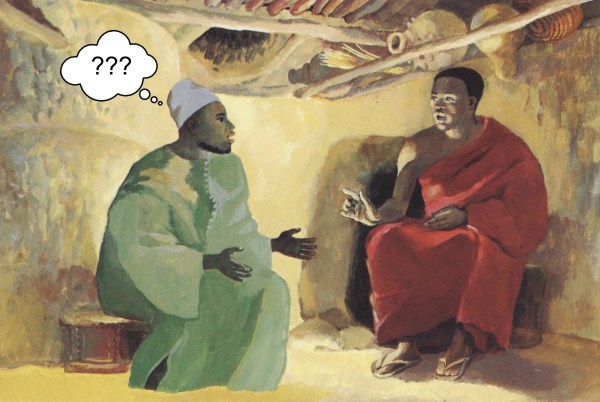
Nicodemus really doesn’t get it.  Bless his heart.  In our gospel reading for this morning, he shows up on Jesus’ doorstep in the middle of the night, wanting to have a conversation.  I’m not sure why he came by night – it might be that he didn’t want the other leaders to see him there; or it could be that there was something weighing on Nicodemus’ heart, something that was keeping him up at night.  

Whatever the case, he comes to Jesus, eager to talk.  Nicodemus starts off by acknowledging Jesus’ authority, saying that we – not just “I,” but “we” – know that you are a Rabbi, a teacher like us, one who has come from God.  Even the other Pharisees have to admit the evidence in front of their eyes, because no one could do the signs you do apart from God.  

And before Nicodemus can continue, Jesus says to him, “Very truly, I tell you, no one can see the kingdom of God without being born from above.”  Huh? This abrupt turn in conversation completely baffles Nicodemus.  He takes it in the most hilariously literal direction and asks Jesus: How can it be possible for someone who has already grown old to somehow go back into their mother and be born again??  What???  But instead of helpfully explaining his statement, Jesus doubles down and says again that one must be born again or be born of water and Spirit, in order to enter the kingdom, and he continues on in that vein from there.  It quickly becomes clear to Nicodemus that he, Jesus, and the other Pharisees are not operating on the same level at all.  

Continue reading “Sermon: Frankly, I Still Don’t Get It”

Sermon: Learning from the Best

Sunday, March 1, 2020
St. John’s Lutheran Church, Schuyler, NE
First Sunday in Lent

Something that I am really grateful to my mom for is that she instilled in me a great love for reading.  She was a teacher – no surprise there – and some of my earliest memories of her are of seeing her curled up on the end of the couch with her big, owl-like reading glasses perched on her nose and a book in her hand.  And of course, she always used read to me, especially before bedtime.

As a little girl, I wanted to be just like my mom, so I was really, really eager to learn how to read.  I was obsessed with the idea of being able to read before I started school – and I was bound and determined that I was going to make that happen.  I remember bursting into my parents’ room one day when I was maybe four or five years old, excitedly yelling, “Mom, Mom, look; I can read!”  I insisted that I was going to read to her for a change.  So I made her sit down on the bed and I ran to get one of my favorite books – The Little Red Caboose – and I sat down next to her, and page by page, I excitedly “read” the whole story to her. 

Mom let me down gently.  She chuckled at my enthusiasm and thanked me for wanting to read to her.  But she also pointed out that I wasn’t really reading quite yet; I had just heard the story so many times that I’d basically memorized more or less what was on each page.  I got so mad when she told me I wasn’t doing it right.  But she told me that it was something that would just take time and practice and patience to get better at.  (My three least favorite things)

Continue reading “Sermon: Learning from the Best”

Blog at WordPress.com.

Up ↑