
Sunday, June 11, 2023
St. John’s Lutheran Church, Schuyler, NE
Second Sunday after Pentecost
watch this service online (readings start around 17:16; sermon starts around 24:42)
In his letter to the Romans, Paul talks about the story of Abraham. He extols Abraham’s faith for being strong and “unwavering” in the face of adversity. However, when you go back and read the original story of Abraham, written in the book of Genesis, the portrait it paints of him is not quite so staunch and stoic.
It’s not that Abraham is unfaithful. It’s just that he is keenly, painfully aware of the realities of his situation. For instance, he is very aware that he is – to put it in biblical terms – old. Like, really old. Paul literally describes him as being “as good as dead” – not to mention that his wife Sarah isn’t exactly a spring chicken herself.
Abraham and Sarah are both very aware of what an impossible thing this is that God is promising them. At this point, their hopes of having children of their own are decades past their expiration date. And that is a deeply painful truth they’ve had to face. For any woman at the time, being barren was generally a source of immense shame, which I imagine Sarah felt. And Abraham laments to God that he has no one to inherit the wealth and security he has worked so hard to establish, no one to carry on his legacy. He asks God, “O Lord God, what will you give me? For I continue childless… you have given me no offspring.”
God repeatedly reassures an anxious Abraham that he and Sarah will be the ancestors of a multitude of descendents, just as God has promised. But Abraham finds that it’s hard to wait with patience for something that seems impossible.
This is a feeling that I imagine the woman in our gospel reading could probably relate to. She has also been waiting a long time for a potentially impossible thing. Unfortunately, none of the gospel writers give this woman a name; so I was joking with the bishop earlier this week that since it seems like every other woman in the New Testament is named Mary, you could make the case for referring to her as Bloody Mary, lol.
Whatever her name, she’s had it rough. For twelve long years, she has been suffering from hemorrhages without relief. And because of the particularly… visceral nature of her illness, odds are she was probably separated from her community and forced to live in isolation because of her perceived uncleanness. For twelve years, she has spent every last cent she had going to doctor after doctor after doctor, enduring painful and humiliating medical treatments, all without result. Now she is worn out and penniless and alone and still no closer to getting better. After all that time, I can imagine the prospect of relief must seem practically impossible.
Jesus encounters this woman on the way to yet another impossible situation. Just as Jesus had been sitting down to dinner, a leader of the synagogue suddenly burst into the house, begging for Jesus to help his daughter. Matthew doesn’t name him, but Mark and Luke call him Jairus. Jairus asks Jesus to come lay hands on his young daughter, who has just died. We have no idea whether this was a sudden accident or if she had also been suffering from a lengthy illness – though I can imagine that every second it took for Jairus to run to the house where Jesus was staying probably felt like a century. Jairus knows that what he is asking of Jesus is an absurdly impossible thing, but like the woman with the hemorhhages, he is at the end of his rope, so he takes a chance.
There is a thread of desperation that runs through all three of these stories. By all appearances, their situations are hopeless; they are out of options and there is nothing left for them to do. And each one of them is fully aware that all the odds are stacked against them, even as they try to find a way forward.
It’s a fact that’s not lost on the other people in their lives. They clearly seem to think these people are crazy for clinging to hope, and they don’t hold back in saying so. When Sarah hears about this promise that she and Abraham will have a son, she straight up laughs – like, “Yeah right!” The bleeding woman’s doctors seem to have given up on her long before she has given up on herself, writing her off as a lost cause with a disease they don’t know how to cure. And Jairus’ daughter is already dead by the time he asks Jesus for help – I can imagine that the mourners at his house who laugh at Jesus probably also scoffed at the fact that Jairus went for Jesus’ help in the first place.
“You are too old.” “There is no cure.” “The girl is dead.” “It’s time to give up.” But these three don’t give up. Instead they choose to believe – and not just believe; they choose to risk hope by putting their faith in God to do the impossible – and God does not disappoint them.
Abraham believes the promise that God makes to him, and though it takes several years (and he doesn’t get any younger) eventually we see Sarah laughing with joy at the birth of their son Isaac.
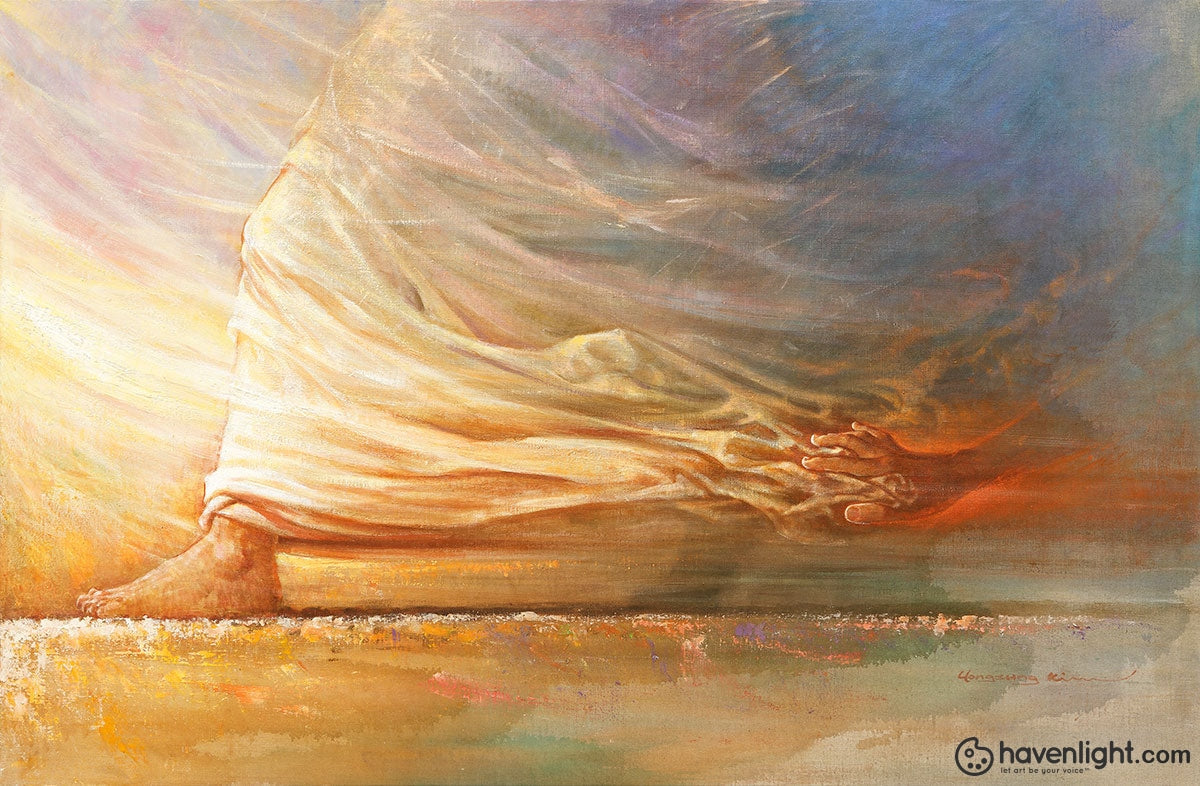
The bleeding woman hears that Jesus, this great teacher and healer is coming to town, and though she has lived in isolation for over a decade, she musters the courage to make her way through the crowds, just to touch Jesus’ cloak. Jesus stops in his tracks and turns to her, and says those words she has been longing to hear: “Take heart, daughter; your faith has made you well.”
And Jairus risks such great hope that he doesn’t even let death slow him down. He has heard about the powerful things that this Jesus can do – and indeed, all it takes is for Jesus to take Jairus’ daughter by the hand, and his child lives once again.
Faith plays a key role in all three of these stories. Abraham’s faith in God is “reckoned to him as righteousness.” Jesus tells this woman with the hemorrhages that her faith has made her well, and I imagine he would say the same thing of Jairus. Yet this faith is more than what we might think of when we hear the word “faith.” It’s not that these folks spun the wheel and landed on the “correct” set of things to believe, that solved all their problems.
In fact, this faith is less about what they believe and more about who they believe. Faith is about trusting God, who promises good things to us. Faith is a matter of relationship – a relationship of trust in which we allow ourselves to be vulnerable, to open our hearts to the hope that God is who God says, to trust in God’s abiding love for us.
And faith is lived out not just in words or thoughts, but in action. As with the folks in these stories, faith tunes us in to where God is present and active. It enables us to hear how God is calling to each of us in our own lives. And it gives us the boldness to believe and to follow, even when what God is calling us to seems impossible.
This is what truly pleases God about Abraham. It’s not that he’s a perfect follower of the law or that he holds the right beliefs. It’s that he’s willing to open his heart in relationship with God. It’s that he’s willing to trust God enough to act on faith, long before God’s promise is realized. And ultimately, this is exactly how the promise to Abraham is fulfilled. As Paul writes, it’s not through the law, but through the righteousness – the right relationship-ness – of faith.
We inherit the faith of Abraham, along with the promises God has made. Through our faith, we too can do extraordinary things – not because believing certain things gives us magic, but because listening for God’s call in our lives and trusting it enough to answer can transform us and the world around us in ways we never thought possible. Because our hope is rooted in faith – and our faith is in a God for whom nothing is impossible.
 This is the Day
Leave a comment