Sunday, November 5, 2023
Spirit of Hope Lutheran Church, Lincoln, NE
All Saints Sunday
(narrative lectionary)
watch this service online (readings start around 28:27; children’s sermon starts around 33:14; sermon starts around 44:12)
Reading: 1 Kings 18:17-39
In the children’s message today, I pitted the children against one another and tried to get them to peer pressure one another to join one of two teams: Team Purple Bat and Team Two Snakes (I had a bunch of random toys leftover from Halloween). We talked about what peer pressure is and what it feels like, and how it can be hard sometimes to know what is right when so many voices are telling you what to do. I likened it to what the people of Israel are experiencing in the reading, as both Elijah and the 450 prophets of Baal are trying to convince them which god(s) they should worship. Elijah reminds the people of who God is and what God has done for them and then seals the deal with an over-the-top fiery display of divine power.
Since we last left the people of ancient Israel, things have gone massively downhill for them. You might remember that last Sunday we read about how a guy named Rehoboam, the son of King Solomon, managed to split the people of Israel into two kingdoms: the Kingdom of Judah and the Kingdom of Everybody Else. Since then, the divided kingdoms have both had a string of lousy kings, each one worse than the last. They have neglected their neighbor; they have failed to repair their relationship with their own kin – and you can easily imagine that their relationship with God is in an even worse state!
But by the time we get to our reading for today, they have reached a new low with the rise of a new king named Ahab. Prior to Ahab, the kings of the northern kingdom (AKA the kingdom of everbody else) hadn’t set the greatest examples for their people, but they at least kind of let people do whatever they wanted to do as far as which gods they followed. But Ahab and his wife Jezebel decide to actively persecute those who are devoted to God. They tear down all the altars across the kingdom and they kill every last prophet they can get their hands on. As Elijah says, he alone is left, since all the other surviving prophets have either hidden themselves or fled.
But God is not done with Elijah. Shortly before Elijah himself goes into hiding, God tells him to go to Ahab and to prophesy that there will be a massive drought. This royally infuriates Ahab; and he spends the next several years trying to hunt Elijah down – I guess he didn’t get the concept of, “Don’t shoot the messenger.”
Elijah hides with a widow in a town called Zarephath. She agrees to let him stay with her even though she and her son are already at death’s door. But God provides for them all – the widow’s little jar of meal and jug of oil never run out; and with God’s power, Elijah even brings her son back from the dead!
After three long years of famine and drought, God finally decides that Ahab has had enough. God sends Elijah back to talk to Ahab and Elijah issues this challenge that we read today: Let’s see whose god is really God – Baal, or the God of Israel. So they gather together all the people of Israel, all the prophets of Baal and Asherah, Ahab and Jezebel, and Elijah himself – they all come together on this mountain.
Elijah says to the people, “Listen, y’all can’t keep going on like this – limping along, professing these two opposing faiths. You need to decide where you stand – whether you believe that Baal is God or you believe that God is God.” But the people don’t say anything. So Elijah proposes a test. He says: Let’s bring out two bulls and set up two altars for burnt offerings. You prophets of Baal, you call on the name of your god, and I’ll call on mine, and we’ll see whose offering ends up getting toasted.
Everybody likes this idea, so they all hop to it. The prophets of Baal set up their offering first and start crying out to Baal to rain down fire – but nothing happens. They go limping around their altar, calling on Baal for hours on end, even cutting themselves in hopes of getting their god’s attention, but their bull doesn’t even get so much as medium rare. And Elijah is just having a field day with this – he mocks the prophets of Baal, saying, “Oh, I bet he’s just taking a nap, or maybe he’s in the bathroom or something – you should definitely keep on trying; I’m sure it will work eventually.”
After this whole scene plays out, Elijah turns to the people and says, “Hey – come with me.” He brings them to the altar of the Lord, which had been torn down. And before he lays out the sacrifice to be burnt, Elijah carefully rebuilds the altar in God’s name, using twelve large stones. There’s no big speech or sermon, but there is a whole lot that is being said here without words. With these twelve stones, Elijah is reminding the people of their unity as the twelve tribes of Israel – he is reminding them of who they truly are.
And even more than this, Elijah is reminding them of who God is. He is pointing them back toward the long history of God’s faithfulness to their ancestors: the covenant with Abraham, the miraculous birth of Isaac, the blessing of Jacob, the rescue from slavery in Egypt, the journey to the promised land, all these things – Elijah reminds them that they belong to a powerful God who loves them and who has done good for them time and time again.
And in case those twelve stones weren’t enough to make his point, Elijah then calls for twelve jars of water to be poured over this sacrifice – so much water that it soaks the offering and the wood and runs down to fill a trench all around it.
It’s only after he’s done all this that Elijah finally calls out to God. And if you look at what he prays, he doesn’t beg God to send down fire like the prophets of Baal do; his prayer is almost more a declaration of faith and praise – he says: “O Lord, God of Abraham, Isaac, and Israel, let it be known this day that you are God in Israel, that I am your servant, and that I have done all these things at your bidding. O Lord, answer me, so that this people may know that you, O Lord, are God and that you have turned their hearts back.”
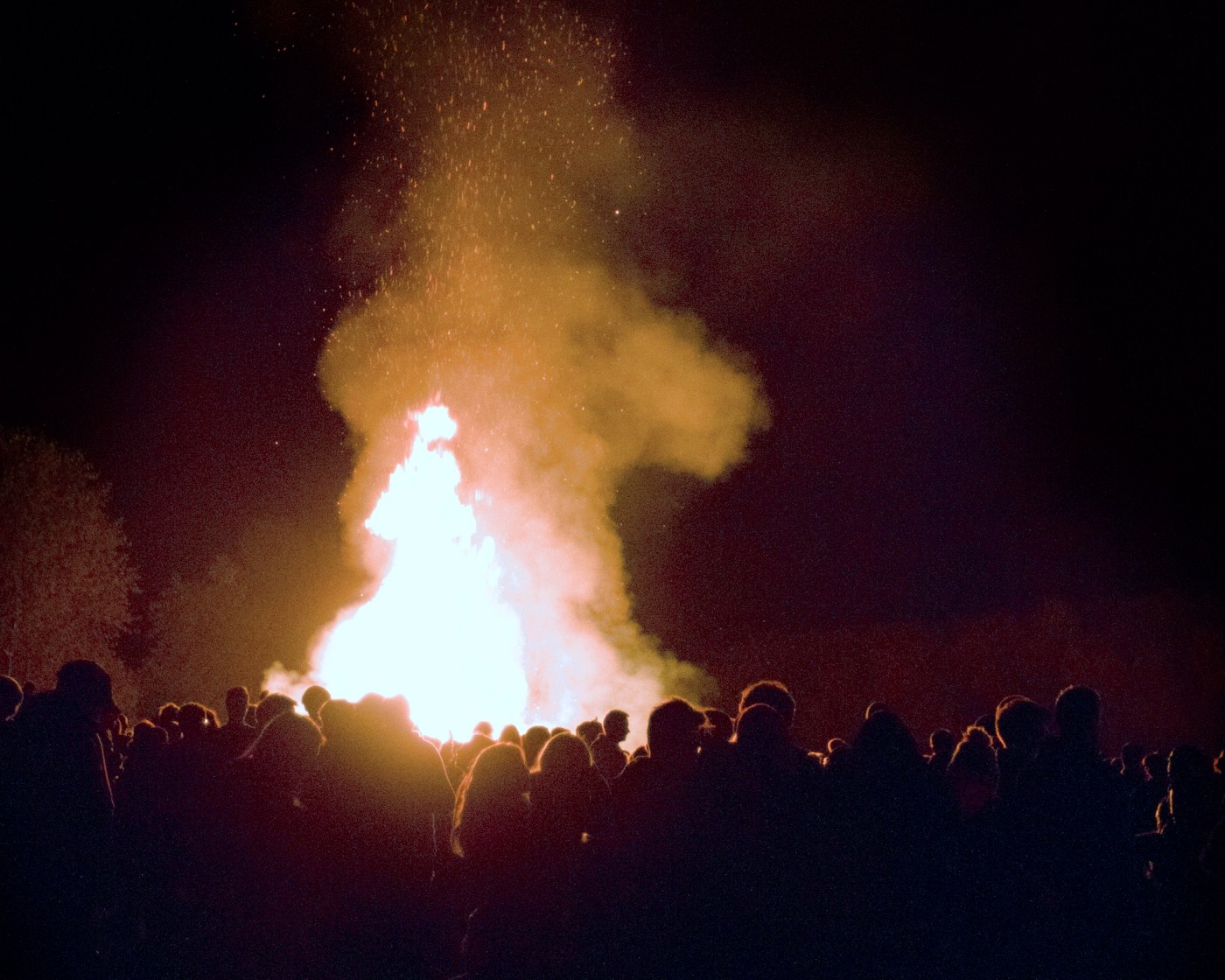
God answers Elijah’s prayer. Holy fire blazes down and it burns up everything – the bull, the wood, the stones, the dust, even the water, down to the very last drop. And in the next few verses, the rains come and the drought finally ends.
It’s an awesome story – honestly, I think it would make a great movie. That being said, it’s maybe not the most relatable story when it comes to talking about our daily lives as people living in the 21st century. We’re well past the practice of sacrificing bulls. And in our pluralistic world, we know that there’s actually a lot we can learn and appreciate about people who don’t share our faith, rather than feeling like we have to fight them.
But there is this question at the heart of the story about where we put our trust and faith – this question about what we give our hearts to. We are called to put our ultimate trust in God to save us and provide for us, but we we face all kinds of temptation to turn aside to other gods instead – not to Baal, typically, but to things like money or relationships or status or stuff.
It’s a conflict that’s central to what it means to walk in this world as disciples of Christ. And as a preacher, I feel like this conflict about where we put our faith is one that I have written and spoken about many, many times. But in recent weeks, I’ve been viscerally reminded that it’s easy to talk philosophically about choosing where we place our faith, and much harder to actually live it out.
The last month has been kind of challenging and intense for me. My doctor and I have been getting closer to diagnosing me with some kind of autoimmune arthritis – and of course, I fell in the shower a couple weeks ago and messed up my knee – which are the kinds of things I would expect to happen to me much later in my life, and not before I’m even forty. I also had my first mammogram this past month (it was clear, thanks be to God!), and I underwent genetic testing for cancer – because I realized that I am almost exactly (like, almost down to the month) the same age my mom was when she was diagnosed with cancer. All of these things have really forced me to contemplate my own limitedness as a human – to be aware of the reality of my own mortality.
It’s made me realize, when it comes right down to it, that I often tend to trust a lot more in my own energy and gifts and abilities to make things happen than I immediately trust in God. I imagine that many of you can relate to that on some level as well. Like Elijah accuses the people of Israel, I don’t always stand as firm in my faith as I’d like to think I do, but instead I find myself limping along after other gods – sometimes literally.
But the wonderful thing is that – even though Elijah isn’t here to roll his eyes at me and put on a big, fiery show – God’s trustworthiness still shines out all the brighter amidst my own failings. When we inevitably reach the end of our human limits, God’s got us every single time.
And that truth shines especially on a day like today, as we celebrate All Saints Sunday. It’s a day to give thanks for the witness of all the faithful who have gone before us. And it’s a bittersweet day on which we remember all the loved ones we have lost – loved ones that no lesser gods like money or knowledge or possessions or skill could ever bring back to us.
As hard as it is to have to let go of our faith in other gods to save us, today we hear what good news that actually is for us. Because we are called to put our faith in something much greater than ourselves. We are called to put our faith in God, who will never fail us nor forsake us.
The story that Elijah tells with those twelve stones is our story too. It’s the story of a God who has power over fire and water, over drought and rain, even over death and life. It’s the story of our God, who brings hope and liberation and new life.
We belong to a powerful God who loves us, a God who has done good for us time and time again, a God whose love will hold us fast together with all God’s people – in our living, in our dying, and forever.

 This is the Day