Sermon: It Takes More Than Words to Build a House of Prayer for All Peoples

Sunday, August 20, 2017
Peace Lutheran Church, Las Cruces, NM
Eleventh Sunday After Pentecost

This has been a disturbing and difficult week for our country. I’m sure you all, like me, have been horrified by the news of the violence in Charlottesville. The hatred displayed by these groups is poisoning our nation with violence; and their white supremacy and antisemitism are sin and evil that have no place in the body of Christ. Continue reading “Sermon: It Takes More Than Words to Build a House of Prayer for All Peoples”

Sermon: Invasion of the Strawberries

Sunday, July 30, 2017
Peace Lutheran Church, Las Cruces, NM
Eighth Sunday After Pentecost

Matthew 13:31-33, 44-52
Jesus put before them another parable: “The kingdom of heaven is like a mustard seed that someone took and sowed in his field; it is the smallest of all the seeds, but when it has grown it is the greatest of shrubs and becomes a tree, so that the birds of the air come and make nests in its branches.”

He told them another parable: “The kingdom of heaven is like yeast that a woman took and mixed in with three measures of flour until all of it was leavened.”

“The kingdom of heaven is like treasure hidden in a field, which someone found and hid; then in his joy he goes and sells all that he has and buys that field.

“Again, the kingdom of heaven is like a merchant in search of fine pearls; on finding one pearl of great value, he went and sold all that he had and bought it.

“Again, the kingdom of heaven is like a net that was thrown into the sea and caught fish of every kind; when it was full, they drew it ashore, sat down, and put the good into baskets but threw out the bad.  So it will be at the end of the age. The angels will come out and separate the evil from the righteous and throw them into the furnace of fire, where there will be weeping and gnashing of teeth.

“Have you understood all this?” They answered, “Yes.”  And he said to them, “Therefore every scribe who has been trained for the kingdom of heaven is like the master of a household who brings out of his treasure what is new and what is old.”

Continue reading “Sermon: Invasion of the Strawberries”

Sermon: Summing it Up

Sunday, June 11, 2017
First Lutheran Church of Logan Square
Trinity Sunday

I was never very good at math in school – in fact, math was always my worst subject. I had hoped that after I graduated from college, I’d never have to worry about anything more than just simple math ever again. But now in seminary, I’m finding myself having to do math all over again! And the problems have gotten a little more complicated.

Today, we have a very complex math problem, and I want to see if you all can guess the right answer. Are you ready? Ok, here goes. What is 1 + 1 + 1? … In our “theological math,” our faith tells us that 1 + 1 + 1 equals 1 – that is, one God in three persons, three persons in one God. Continue reading “Sermon: Summing it Up”

Sermon: Lured Toward the Future

Monday, May 8, 2017
Epic of Creation Course (final project)
LSTC

Romans 8:18-25
I consider that the sufferings of this present time are not worth comparing with the glory about to be revealed to us. For the creation waits with eager longing for the revealing of the children of God; for the creation was subjected to futility, not of its own will but by the will of the one who subjected it, in hope that the creation itself will be set free from its bondage to decay and will obtain the freedom of the glory of the children of God. We know that the whole creation has been groaning in labor pains until now; and not only the creation, but we ourselves, who have the first fruits of the Spirit, groan inwardly while we wait for adoption, the redemption of our bodies. For in hope we were saved. Now hope that is seen is not hope. For who hopes for what is seen? But if we hope for what we do not see, we wait for it with patience.

Continue reading “Sermon: Lured Toward the Future”

Wells in the Wilderness

For about the last year, I have been worshiping with the community of St. Luke’s Lutheran of Logan Square — on the Sundays I haven’t been preaching elsewhere, of course.  I chose St. Luke’s because they are a vibrant and visionary community that had the courage to sell their building and open up shop in a storefront, and because of their deep commitment to social justice — and also, largely, to “low-key stalk” my dear friend Erin while she completed her internship year there.

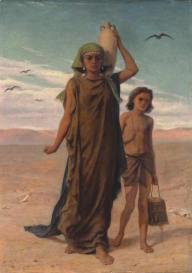
hagar-ishmael-augo4Anyhoo, one of the neat things St. Luke’s does is to engage the congregation in a regular practice of testimony, often inviting laypeople to prepare testimonies from their own lives around a certain theme to read in worship.  This past Sunday was my last Sunday at St. Luke’s before I move to New Mexico for internship (by the way, I’m moving to New Mexico for internship — forgot to make that announcement!).  It seemed incredibly fitting that I should answer a question about experiencing God in the desert before embarking on a literal journey to a literal desert.

My testimony was related to the Hebrew Testament reading — Genesis 21:8-21 — in which Hagar and her son Ishmael are kicked out into the desert by Abraham’s wife Sarah.  I was asked to respond to the question, “When was a time when you experienced God/good news in a place of isolation, abandonment, death?”  This is what I wrote:

Continue reading “Wells in the Wilderness”

Waging Holy War with the DSM-5

CW: fatphobia, eating disorders, IWL/diet talk

Introduction

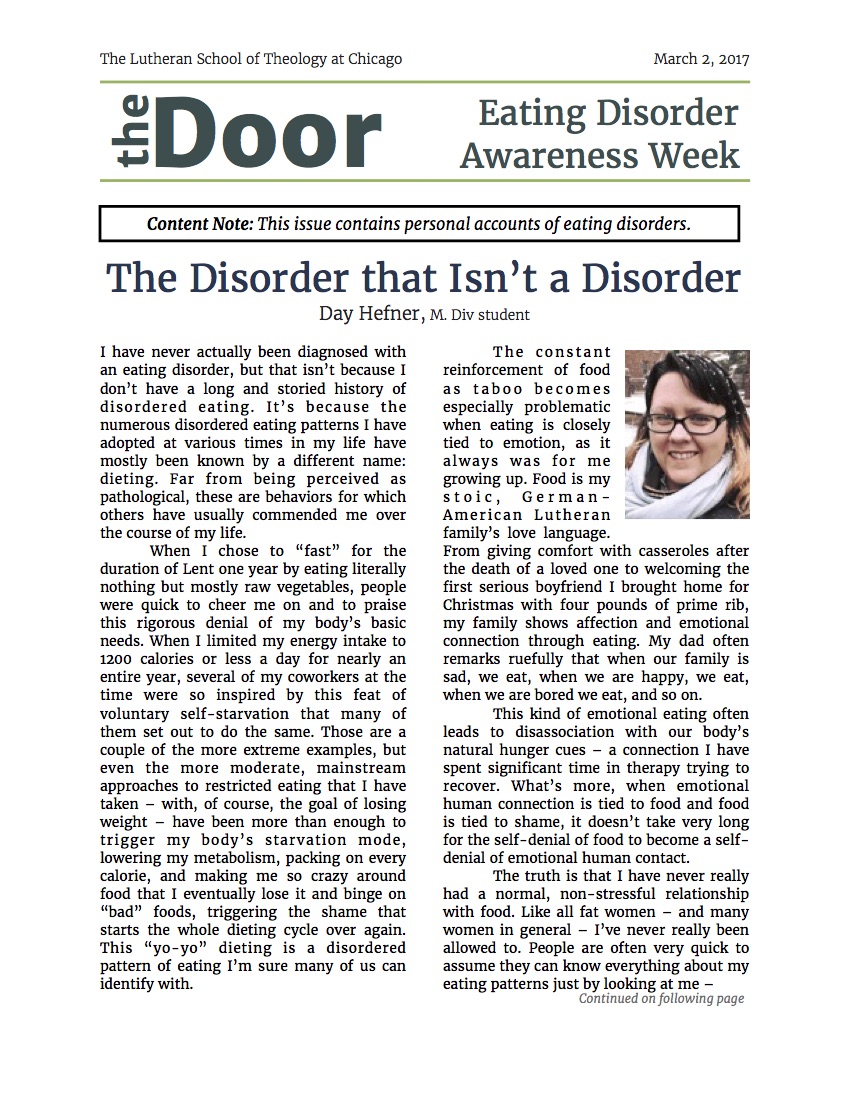
“Nothing tastes as good as skinny feels”; this was the oft-repeated mantra of the doctor who once helped me lose over 30 pounds (after having already lost 40) in a little under three months by dramatically restricting my diet. Her words are symptomatic of a larger trend that is deeply entrenched in the medical industry, namely, an underexplored and oversimplified conflation of health and wellbeing with weight. The automatic attribution of poor health to body size has led to an emphasis on reducing body mass, often to the detriment of health. By identifying fatness as a problem in and of itself, the medical industry has made itself a complicit player in the size-ism and weightism that run rampant in U.S. and other developed societies, lending professional credibility to the “fatphobic” attacks of the diet, fitness, and fashion industries on fat individuals. Eating disorders, particularly anorexia nervosa and bulimia nervosa, are a logical consequence of this rampant weightism and size-ism, a natural response to the medically reinforced notion that thin = good and that fat must be avoided at all costs.

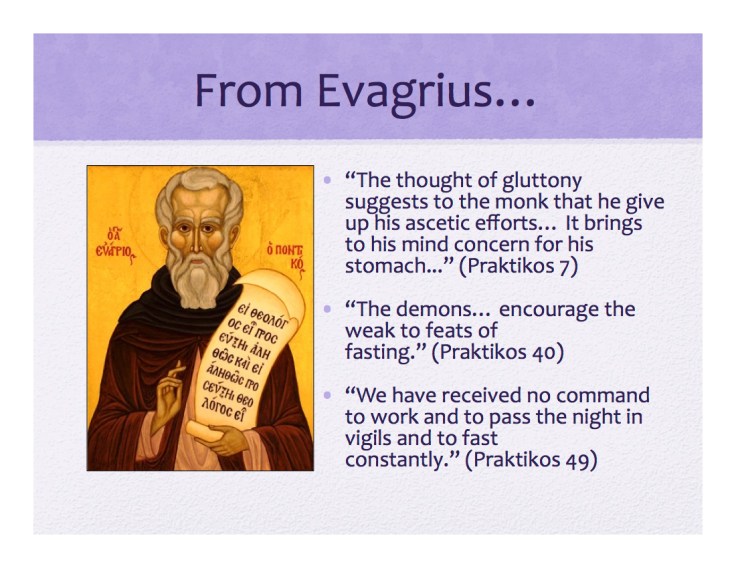
The church has resources that can help heal our society’s disordered and unhealthy relationship to both food and body. These resources date back to the early centuries of Christianity; in particular, this paper will explore the relevance of the writings of Evagrius Ponticus, a fourth century Egyptian desert monk, and Gregory the Great, a sixth century Roman pope. Both of these Christian figures wrote extensively about the ancient church’s understanding of gluttony, and about how the relationship between self, neighbor, creation, and God is properly to be understood. Two other key tools in the ecclesial toolkit are a theological affirmation of the inherent goodness of creation, and a robust theology of incarnation. Together, these resources present a countercultural and life-giving alternative to our eating disordered society that is deeply rooted in God’s love and promises. Continue reading “Waging Holy War with the DSM-5”

Recovering Ancient Understandings of Gluttony

Book Review/Reflection for Class:
The God of Thinness: Gluttony and Other Weighty Matters by Mary Louise Bringle

Mary Louise Bringle lays out her book, The God of Thinness: Gluttony and Other Weighty Matters, after the fashion of a meal, titling her chapters “Apértif,” “First Course,” “Second Course,” and so on. I found it fitting, because this book was, indeed, a rich feast of reflection on the issue of gluttony and its relationship to the culture surrounding weight, food, and dieting in our society. I also appreciated that this book was suffused with Bringle’s own struggles with disordered eating and self-image; she conveys a gravity and emotional complexity around this issue which I also deeply feel. Bringle opens up the riches of Christian tradition, history, and theology to respond to this still current question of gluttony. She explores patristic and monastic writings for wisdom on how gluttony is rightly to be understood; I particularly found her discussion of Gregory the Great’s five kinds of gluttony to be clarifying and helpful. And she ultimately shows that gluttony is a matter of disordered priorities that idolize the goodness of creation above its Creator, resulting in damaged relationship to God, to neighbor, and to self. This book was published 25 years ago, but it continues to be extremely relevant.

Evagrius P Continue reading “Recovering Ancient Understandings of Gluttony”

Making Space for Mystics and Madness

Here’s another bit of writing from one of my classes this semester, this one from the Pastoral Care and Mental Illness course I’ve been taking.  This particular course has had some interesting overlap with another of my classes: Desert Discipleship, which explores the legacy of the desert fathers and mothers of the early centuries of Christianity.  In this assignment, which I conceived as an article for a church newsletter, I propose a connection between schizophrenia and the legacy of St. Anthony.  Enjoy!


st-anthony-the-great-3St. Antony, also known as Anthony the Great, was a Christian monk who lived in Egypt in the third and fourth centuries. He renounced the wealth left to him by his parents and chose to live an ascetic life in the desert, fasting and meditating on Christ. Antony became a wise and famous figure of Egyptian monasticism, but more than anything, he was known for his battles with demons.

St. Athanasius, the fourth century bishop of Alexandria, described these battles in The Life of Antony, which quickly became one of the most popular books in Christian history. Many modern readers will find these accounts more than a little odd, but there was something about Antony’s life and his battles with the demons that earlier generations undeniably found compelling. Athanasius describes how Antony withdraws further and further into the desert, at one point enclosing himself in a deserted barracks and receiving stores of food only twice a year. Athanasius writes:

Those friends who came to see him, since he would not allow them to come inside, often remained outside day and night. They heard what sounded like mobs of people creating a ruckus and crashing around inside, letting loose their pitiful voices and crying out, “Get away from what belongs to us! What are you doing in the desert? You will not be able to endure our connivings!” Those outside at first thought some people… had gotten inside by means of ladders… but when they knelt down to look through a hole in the wall, they did not see anyone. (Athanasius, 2003, p. 89)

1an33__24635_1405404609_900_900Antony instructs his followers to be wary of these demonic voices, telling them that they fill one’s head with “filthy thoughts” and cause “apparitions,” that “they pretend to frighten us by changing their shapes and taking on the appearance of women, wild beasts, reptiles…” (Athanasius, 2003, p. 113)

Hundreds of people flocked to the desert to be taught by Antony, to the point that Athanasius writes that they “forcibly tore down his door and forced him to come out.” (Athanasius, 2003, p. 91) Reading this in the 21st century, I have a hard time imagining this happening in our day. Even though the Christian church has centuries of history and tradition of mysticism and mystery, I can’t imagine people rushing out to sit at the feet of anyone who heard voices and saw apparitions and warned others about demons putting thoughts into their heads today. Can you? If St. Antony lived today, many folks would probably be pretty quick to label him a schizophrenic. They would probably say that he was crazy. Continue reading “Making Space for Mystics and Madness”

Sermon: Eyes of Faith

Thursday, April 27, 2017
James Kenneth Echols Prize for Excellence in Preaching Event
Augustana Chapel, Lutheran School of Theology in Chicago

Screen Shot 2017-09-06 at 11.19.14 AM

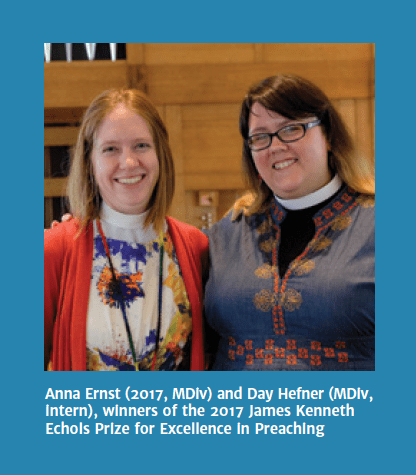
My friend Anna and I were finalists for the winners of our seminary’s annual preaching prize, and we both had the privilege of preaching our sermons, based on the road to Emmaus story, in chapel last Thursday.  Here is mine, and here is Anna’s.

Manuscript follows below.

s463025724710779803_p176_i66_w600Luke 24:13-35 (The Walk to Emmaus)
Now on that same day two of them were going to a village called Emmaus, about seven miles from Jerusalem, and talking with each other about all these things that had happened. While they were talking and discussing, Jesus himself came near and went with them,  but their eyes were kept from recognizing him.  And he said to them, “What are you discussing with each other while you walk along?” They stood still, looking sad. Then one of them, whose name was Cleopas, answered him, “Are you the only stranger in Jerusalem who does not know the things that have taken place there in these days?” He asked them, “What things?” They replied, “The things about Jesus of Nazareth, who was a prophet mighty in deed and word before God and all the people, and how our chief priests and leaders handed him over to be condemned to death and crucified him. But we had hoped that he was the one to redeem Israel. Yes, and besides all this, it is now the third day since these things took place.  Moreover, some women of our group astounded us. They were at the tomb early this morning, and when they did not find his body there, they came back and told us that they had indeed seen a vision of angels who said that he was alive. Some of those who were with us went to the tomb and found it just as the women had said; but they did not see him.” Then he said to them, “Oh, how foolish you are, and how slow of heart to believe all that the prophets have declared! Was it not necessary that the Messiah should suffer these things and then enter into his glory?” Then beginning with Moses and all the prophets, he interpreted to them the things about himself in all the scriptures.
As they came near the village to which they were going, he walked ahead as if he were going on. But they urged him strongly, saying, “Stay with us, because it is almost evening and the day is now nearly over.” So he went in to stay with them. When he was at the table with them, he took bread, blessed and broke it, and gave it to them. Then their eyes were opened, and they recognized him; and he vanished from their sight. They said to each other, “Were not our hearts burning within us while he was talking to us on the road, while he was opening the scriptures to us?” That same hour they got up and returned to Jerusalem; and they found the eleven and their companions gathered together. They were saying, “The Lord has risen indeed, and he has appeared to Simon!” Then they told what had happened on the road, and how he had been made known to them in the breaking of the bread.

Continue reading “Sermon: Eyes of Faith”

Cancer, Evolution, and a Creation Stumbling Forward

I have been taking a particularly fascinating (and challenging!) course this semester called “The Epic of Creation: Scientific, Biblical, and Theological Perspectives on Our Origins.”  While many of our class sessions have been (to my mind) thickly scientific and technical and rather over my head, last Monday, we had a deeply engaging conversation about theological and pastoral perspectives on cancer as an evolutionary phenomenon.  Given my family history of cancer — most notably, my mother’s death from breast cancer in 1994 — this is a topic that is very near and dear to my heart.  I rushed home after class to write my reflections about all that we had discussed, and after re-reading what I wrote, I decided to share some of it here.  I hope it’s meaningful for others as it is for me.

Continue reading “Cancer, Evolution, and a Creation Stumbling Forward”

Sermón: Palmas y perspectivas

Domingo de ramas / Palm Sunday
9 abril, 2017 / April 9, 2017
Mateo 21:1-11 / Matthew 21:1-11
First Lutheran Church of Lutheran Square

(I also submitted this sermon as an assignment for my preaching class, so I experimented with a different approach to writing a sermon.  I hope you enjoy it!  It also preceded an action with the Logan Square Ecumenical Alliance, supporting reforms of Chicago’s Welcoming Cities Ordinance.)


(sermon starts around 2:04)
(manuscript is below)

Continue reading “Sermón: Palmas y perspectivas”

Sermon: Truth from the Margins

Third Sunday of Lent / Tercer domingo de cuaresma
March 19, 2017 / 19 marzo, 2017
John 4:5-42 / Juan 4:5-42
First Lutheran Church of Lutheran Square

0e6ef653fa10cdcb6a77686873a70189La única cosa que le interesaba a Kenny era Bionicle – un mundo de ciencia ficción y fantasía creado por Lego, con ciborgues, robotes, y monstruos. Le conocí a Kenny durante el verano de 2006 cuando trabajaba como consejera en un campamento luterano de jóvenes. A mi me tocaba cuidar a un grupito de siete campistas: 3 niñas, 3 niños, y Kenny. Kenny era un niño muy amable. Le gustaba mucho dibujar y contar historias – mayormente sobre Bionicle – pero le costaba enfocarse en las actividades del grupo. Dentro de pocos días sus peculiaridades empezaron a molestar un poco a los demás niños, y Kenny se convirtió en un marginado.

Este cuento de la mujer samaritana, me recuerde un poco de Kenny. Como Kenny, la mujer samaritana parecía ser una marginada de su pueblo. Vino sola al pozo a sacar agua durante las horas más calientes del día. En su conversación con Cristo, revela que ha tenido cinco maridos y que ya vive con uno que no es su marido. Posiblemente era adúltera, pero no lo sabemos por seguro. Puede que fuera viuda o hasta divorciada cinco veces. Quizás le obligaron a casarse con varios hermanos de la misma familia por una práctica que se llamaba el matrimonio “levirato,” y ya se quedó sola. Sea lo que sea su historia, el hecho de que estaba sola en el pozo, conversando sobre agua viva con un hombre ajeno, probablemente indica que era un poco diferente a los demás de su pueblo.

Por lo tanto, imagino que cuando ella vino corriendo del pozo, llena de emoción, la última cosa que esperaba su pueblo era que les traía la palabra de vida de Dios. Y yo lo imagino así, porque cuando Kenny vino corriendo a nuestro grupito, lleno de emoción, yo tampoco lo esperaba. Continue reading “Sermon: Truth from the Margins”

My Own Independence Day

CW: diet talk, weight loss, profanity, disordered eating

16807034_903765421345_7226968339658447082_n
Me rocking a new winter coat that actually fits well and looks nice

.

.

.

I quietly celebrated an important anniversary yesterday.  It’s been exactly one year since I gave up dieting and stopped trying to lose weight.  I had been resistant and afraid to do it, terrified that I would lose all control over my eating and constantly gorge myself on all the fatty, fried, and sweet foods I so desperately craved.  I felt like a crazy person around food and even thought that perhaps I was a food addict.  I used to hide my eating from those closest to me who I knew would disapprove: hiding candy in unlikely places (like my closet or behind books on a shelf), hiding myself in the bathroom to sneak my little treats.  I felt guilty and hungry and ashamed all. the. time.

A year ago, I was lying face down on my bed, sobbing uncontrollably, feeling like the most miserable life form in the universe.  I don’t even remember what set me off, if indeed, there even was anything.  I was so sick of dieting, so sick of constantly denying myself the pleasure of eating.  And most of all, I was just unbearably sad.  The ideal of the thin (or even the thinner) me seemed impossibly far out of reach, and getting further by the minute.  I had legitimately given it my best.  I have lost as much as 70lbs in a single go in my life, but without fail, it always comes back, and when it does, it brings along reinforcements. Continue reading “My Own Independence Day”

March 7 Resist Trump Tuesday

International Women’s Strike Chicago: Global Wage Justice
March 7, 2017

I was honored to be invited to speak at the March 7th Resist Trump Tuesday rally as a leader with Seminarians for Justice and The People’s Lobby, fighting for the global minimum wage movement and for the rights and dignity of women and workers everywhere.  Following are some photos of the event, a video of our multilingual call for global solidarity, and a video and manuscript of my speech.

This slideshow requires JavaScript.

Continue reading “March 7 Resist Trump Tuesday”

Sermón: Renunciando el renunciar

ash_weds_cross-1“Domingo de Ceniza” / “Ash Sunday”
5 Marzo, 2017 / March 5, 2017
First Lutheran Church of Logan Square

Mateo 6:1-6, 16-21
Matthew 6:1-6, 16-21

Hoy, empezamos el tiempo de la Cuaresma por observar el Miércoles de Ceniza – o en este caso, el Domingo de Ceniza. La Cuaresma es un tiempo de arrepentimiento, en que renovamos nuestra devoción a la vida de fe. Pero para muchas personas, este tiempo se ha convertido en un tiempo de abnegación solamente. Ha vuelto a ser un tiempo de castigarnos a nosotros mismos y de sentirnos culpables por fallar en vivir vidas perfectas. Igual que los “hipócritas” en nuestro evangelio para hoy, muchos de nosotros pasamos la Cuaresma orando y ayunando – tal vez renunciamos al azúcar o chocolate o a otras cosas que nos gustan. Pero a veces puede ser fácil perder la razón *porque* hacemos estas cosas.

Tal vez ustedes no. Pero yo sé que para mi, ha sido difícil. Por muchos años, mi práctica cuaresmal ha sido renunciar algún tipo de comida. He renunciado al azúcar y al soda y carbohídratos. El año pasado, para la Cuaresma, comí sólo verduras crudas y nada más. Fue muy poco saludable. Y siendo honesta, lo que quería hacer en realidad era continuar mi resolución del Año Nuevo de bajar de peso.

Aunque intentaba convencerme a mi misma que lo hacía para Dios, la verdad es que lo hacía para mi y para quedar bien con los demás. Como los hipócritas en nuestro texto, me preocupaba más por lo que pensaban los demás que por lo que pensaba Dios. Para mi, la Cuaresma no era un tiempo de arrepentirme y volver a Dios, sino un tiempo de castigarme. Continue reading “Sermón: Renunciando el renunciar”

Sermon: Breaking the Cycle

ash_cross(Early) Sermon for Ash Wednesday
February 22, 2017
“Sermon Design and Delivery” course
LSTC

Matthew 6:1-6, 16-21
“Beware of practicing your righteousness before others in order to be seen by them; for then you have no reward from your Father in heaven.

“So whenever you give alms, do not sound a trumpet before you, as the hypocrites do in the synagogues and in the streets, so that they may be praised by others. Truly I tell you, they have received their reward. But when you give alms, do not let your left hand know what your right hand is doing, so that your alms may be done in secret; and your Father who sees in secret will reward you.

“And whenever you pray, do not be like the hypocrites; for they love to stand and pray in the synagogues and at the street corners, so that they may be seen by others. Truly I tell you, they have received their reward. But whenever you pray, go into your room and shut the door and pray to your Father who is in secret; and your Father who sees in secret will reward you.

“And whenever you fast, do not look gloomy, like the hypocrites, for they disfigure their faces so as to show others that they are fasting. Truly I tell you, they have received their reward. But when you fast, annoint your head and wash your face, so that your fasting may be seen not by others but by your Father who is in secret; and your Father who sees in secret will reward you.

“Do not store up for yourselves treasures on earth, where moth and rust destroy and where thieves break in and steal; but store up for yourselves treasures in heaven, where neither moth nor rust consumes and where thieves do not break in and steal. For where your treasure is, there your heart will be also.

“Do not be like the hypocrites,” Jesus warns us in our gospel text for today. Unfortunately, it seems like there’s plenty of hypocrisy to go around these days – especially if you’re attuned to what’s happening in our country’s political discourse. Politicians and public figures claim to be pro-life, while adamantly supporting the death penalty and opposing gun regulation, despite tens of thousands of gun-related deaths annually. Others claim to be advocates for a quality public education system while proposing plans to dismantle the entire Department of Education. Still others are doing everything in their power to slam the door on refugees and other immigrants seeking safety and opportunity, while ignoring their own families’ personal – and recent – histories of immigration. Hypocrisy is the bread and butter of our world. Continue reading “Sermon: Breaking the Cycle”

Sermon: On Baptists and Prophets

Dr. Martin Luther King Jr. Day
Sunday, February 15, 2017
First Lutheran Church of Logan Square

1918-004-16347ac7johnthebaptistpreaching

John 1:29-42
The next day he saw Jesus coming toward him and declared, “Here is the Lamb of God who takes away the sin of the world! This is he of whom I said, ‘After me comes a man who ranks ahead of me because he was before me.’ I myself did not know him; but I came baptizing with water for this reason, that he might be revealed to Israel.” And John testified, “I saw the Spirit descending from heaven like a dove, and it remained on him. I myself did not know him, but the one who sent me to baptize with water said to me, ‘He on whom you see the Spirit descend and remain is the one who baptizes with the Holy Spirit.’ And I myself have seen and have testified that this is the Son of God.” The next day John again was standing with two of his disciples, and as he watched Jesus walk by, he exclaimed, “Look, here is the Lamb of God!”

The two disciples heard him say this, and they followed Jesus. When Jesus turned and saw them following, he said to them, “What are you looking for?” They said to him, “Rabbi” (which translated means Teacher), “where are you staying?” He said to them, “Come and see.” They came and saw where he was staying, and they remained with him that day. It was about four o’clock in the afternoon. One of the two who heard John speak and followed him was Andrew, Simon Peter’s brother. He first found his brother Simon and said to him, “We have found the Messiah” (which is translated Anointed). He brought Simon to Jesus, who looked at him and said, “You are Simon son of John. You are to be called Cephas” (which is translated Peter).

(I never finished translating this sermon, nor got to preach it, as I was quite sick for several weeks)

Today, we celebrate the legacy of a great leader and prophet – a visionary who led a movement that forever transformed his nation. His name was John the Baptist. Just kidding. We are, of course, talking about Dr. Martin Luther King Jr.

However, it does seem profoundly fitting that we should celebrate Dr. King’s life and legacy with a reading about the prophet John. In many ways, Dr. King was a prophet very much in the line of biblical prophets like John: Continue reading “Sermon: On Baptists and Prophets”

Sermon: Hope in the Dark

africa-baby-jesus-refugee-egyptPrimer domingo de Navidad /
First Sunday after Christmas
Domingo 1 enero, 2017 /
Sunday, January 1, 2017
Iglesia Luterana Nueva Esperanza /
New Hope Lutheran Church
Aurora, IL

Mateo 2:13-23 / Matthew 2:13-23

Merry Christmas! Today’s gospel reading seems a little jarring and out of place on the first Sunday of this joyous season of Christmas. After our celebration of angelic hosts and jubilant shepherds, this passage from Matthew feels like a rude awakening. It’s like Joseph, being woken up in the middle of the night by the angel of the Lord – “Get up! Get up, Joseph, and flee for your lives!”

When I first read this text, I immediately thought of the millions of refugee children out in the world right now. Some of them, like Jesus and his family, have been able to flee their countries, and then struggled to find a welcome in other, safer places. But many others are like the young children slaughtered by King Herod – victims of violence and poverty.Al-Azraq Refugee Camp Marks A year Of Housing Syrian Refugees

This text is a stark reminder that, no matter how bright and shining our Christmas celebration may be, the world is still full of darkness and tragedy. Civil war still rages on in places like Syria and South Sudan. Gang violence and corruption drive people north from Central America and Mexico, seeking safety. And even here, where we are relatively sheltered, homelessness and economic inequality abound, and disease, addiction, and death destroy the people we love. Continue reading “Sermon: Hope in the Dark”

Sermon: Signs of the Kingdom

john_the_baptist_in_prison_350Third Sunday of Advent /
Tercer Domingo de Adviento
December 11, 2016 /
11 de diciembre, 2016
First Lutheran Church of Logan Square

Matthew 11:2-11 / Mateo 11:2-11

In our Gospel reading for today, John asks Jesus a question that I find really surprising: “Are you the guy we’ve been waiting for, or should we keep waiting for someone else?” I mean, this is John. The. Baptist. If anyone knows who Jesus really is, shouldn’t it be this guy? You’d think that seeing the heavens cracked open and a dove descending on Jesus and then hearing the voice of God when he baptized Jesus would be pretty convincing proof that Jesus is the Messiah.

But John had hit some really hard times. I mean really hard. After a wildly successful prophetic career, he made the wrong people angry and wound up in prison. And prison in the days of the Roman Empire wasn’t quite like prison is now. Most Roman prison sentences ended one of two ways: with exile, or with execution.

Last week, we heard John’s fiery preaching from the banks of the Jordan; he declared that one was coming who would baptize with the Holy Spirit and with fire! This one would separate the wheat from the chaff and take an axe to the trees that no longer produced fruit! John was waiting for a powerful savior who would liberate his oppressed people. But when Jesus started his ministry, it wasn’t what John expected. There was no fire, no axes. There wasn’t even any wheat, except for the bread that Jesus kept breaking and sharing with everyone.

And so John wondered – “Has my whole ministry been in vain? Did I devote my life to the wrong thing?” Continue reading “Sermon: Signs of the Kingdom”

Grandes promesas: un sermón para el Día de los Santos Muertos de la Reforma-Halloween


img_5634
El altar para el Día de los Muertos en la iglesia luterana Nueva Esperanza

Domingo de Todos los Santos
(Según la predicadora)

Domingo de la Reformación
(Según el director de música)

Domingo 24 después de Pentecostés
(Según la secretaria/liturgista)

Domingo, 30 de octubre, 2016
(Según todos)

Iglesia Luterana Nueva Esperanza, Aurora, IL

Daniel 7:1-3, 15-18
Salmo 149
Efesios 1:11-23
Lucas 6:20-31

.

Las dos semanas que vienen están llenas de días muy importantes y emocionantes. Mañana, la iglesia Luterana celebrará el aniversario de la Reformación, en que Martín Lutero reformó la iglesia Catolica y creó la iglesia Luterana. El día siguiente, la iglesia global celebrará el Día de Todos los Santos, como observamos hoy, y el día después de eso, claro, celebraremos el Día de los Muertos. Además, en la semana que viene, habrá una elección histórica en la cual se decidirá quienes serán los líderes del país por los cuatro años que vienen. ¡Hay muchas cosas!

Pero hoy, me gustaría empezar mis reflecciónes con el día que tal vez menos esperaban: Halloween Continue reading “Grandes promesas: un sermón para el Día de los Santos Muertos de la Reforma-Halloween”

Promises, Promises: An All Saints of los Muertos Reformation-Ween Sermon

img_5634
New Hope’s beautiful Day of the Dead altar

All Saints Sunday
(according to the preacher)

Reformation Sunday
(according to the music director)

24th Sunday after Pentecost
(according to the secretary/liturgist)

Sunday, October 30, 2016
(according to everyone)

New Hope Lutheran Church, Aurora, IL

Daniel 7:1-3, 15-18
Psalm 149
Ephesians 1:11-23
Luke 6:20-31

The next couple of weeks are packed with momentous and exciting events. Tomorrow, the Lutheran church marks the 499th anniversary of the Reformation. The day after that, the global church marks All Saint’s Day, and the day after that, we celebrate the Day of the Dead. And next week, our country will hold a historic presidential election in which we will decide our leaders for the next four years or more. There’s a lot going on!

But I’d actually like to start off today talking about an upcoming day you probably didn’t expect to hear about from the pulpit: Halloween. Continue reading “Promises, Promises: An All Saints of los Muertos Reformation-Ween Sermon”

Sermon: Faith in All the Wrong Places

Sunday, October 23, 2016
New Hope Lutheran Church, Aurora, IL

He also told this parable to some who trusted in themselves that they were righteous and regarded others with contempt: “Two men went up to the temple to pray, one a Pharisee and the other a tax collector. The Pharisee, standing by himself, was praying thus, ‘God, I thank you that I am not like other people: thieves, rogues, adulterers, or even like this tax collector. I fast twice a week; I give a tenth of all my income.’ But the tax collector, standing far off, would not even look up to heaven, but was beating his breast and saying, ‘God, be merciful to me, a sinner!’ I tell you, this man went down to his home justified rather than the other; for all who exalt themselves will be humbled, but all who humble themselves will be exalted.”

Luke 18:9-14

This week’s gospel text reads a little bit like a joke – a pharisee and a tax collector walk into a bar temple. But the punchline of this joke is deceptively tricky. Nowadays, we’re used to reading pharisees as hypocritical bigots and tax collectors as humbly repentant sinners; but the twist at the end of the story where the tax collector’s prayers are justified and the pharisee’s are not would have been more surprising to Jesus’ original hearers than it is to us. In contrast to the pharisee’s prayer thanking God that he is not like the tax collector, we know that the pharisee is the person that we are glad not to be like, right?

Ha! And there’s the punchline of the joke. It’s almost impossible to hear this story and not go away thinking something along the lines of, “God, I thank you that I am not like that pharisee!” As it turns out, we are every bit as judgmental as he is.

modern-phar-tc

It’s a disturbingly easy trap to fall into, and Jesus knows it. It almost seems to be an inherent part of being human that we categorize people into “us” and “them” groups, deciding who is in and who is out. This election season – which will finally end in a little over two weeks – has shown us clearly the depth of division in our country. And that division also shows up in our churches, too – not just between rival denominations, but in and among our own congregations. In our churches, we single out “those people who don’t give enough money” or “those people who don’t take good enough care of the worship space” or “those people who sure don’t act very Christian outside of church” or “those people who hardly ever come to church at all.” We draw lines between ourselves and other groups of people without even thinking about it. But the problem with that – as Jesus illustrates in this story – is that God always ends up on the other side of that line.

Continue reading “Sermon: Faith in All the Wrong Places”

Blog at WordPress.com.

Up ↑