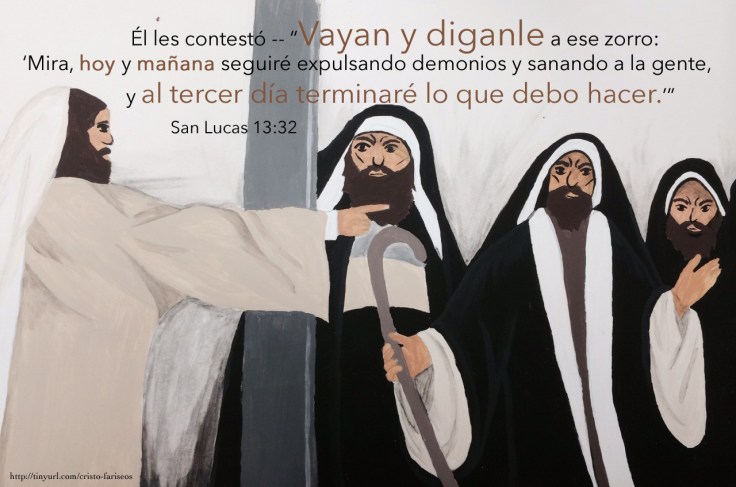
Sermon: Predicando a los Zorros / Preaching to the Foxes

Domingo, 21 de febrero, 2016
Segundo Domingo de Cuaresma
Iglesia Luterana San Andrés, West Chicago, IL
San Lucas 13:31-35 
(English translation follows below)

Cristo y los fariseos

Jesús está predicando en Galilea, sanando a la gente, y expulsando demonios cuando los fariseos se acercan a él. Le amenazan a Jesús, diciéndole que Herodes quiere matarle, y le mandan que huya de la región. Pero, increíblemente, Jesús no les hace caso. De hecho, llama a Herodes un zorro y hasta sarcásticamente sugiere que Herodes lo busque en tres días para matarlo a Jesús en Jerusalén. Continue reading “Sermon: Predicando a los Zorros / Preaching to the Foxes”

Sermon: Chicks Gone Wild

Sunday, February 21, 2016
Second Sunday of Lent
St. Andrew Lutheran Church, West Chicago, IL
Luke 13:31-35

Jesus lament over Jerusalem

Today, we continue our journey through the forty days of Lent. And we walk alongside Jesus, as he makes his way inevitably toward Jerusalem.

In our gospel reading for today, Jesus is totally focused on his goal. The pharisees come to him with death threats from Herod, but Jesus brushes them off. In fact, this is a classic example of what I like to think of as “snarky Jesus.” Jesus calls Herod a “fox” and responds to his threat by basically saying, “Look Herod, I don’t have time for you right now. I’ve got work to do. But hey, I’ve got an opening in three days, so if you still want to kill me, you can come on down to Jerusalem and do it then – because we all know that no prophet can die outside of Jerusalem, amirite?” Jesus basically dismisses Herod and the pharisees because he is so focused on reaching Jerusalem. Because Jerusalem is the stage on which the grand drama of the passion narrative will unfold. Continue reading “Sermon: Chicks Gone Wild”

Sermon 10: Little Seeds of Love / Semillitas de amor

(Se encuentra el texto en español más abajo)

Sunday, November 22, 2015
Christ the King Sunday
St. Andrew Lutheran Church, West Chicago, IL
John 18:33-37
33 Then Pilate entered the headquarters[a] again, summoned Jesus, and asked him, “Are you the King of the Jews?” 34 Jesus answered, “Do you ask this on your own, or did others tell you about me?” 35 Pilate replied, “I am not a Jew, am I? Your own nation and the chief priests have handed you over to me. What have you done?” 36 Jesus answered, “My kingdom is not from this world. If my kingdom were from this world, my followers would be fighting to keep me from being handed over to the Jews. But as it is, my kingdom is not from here.” 37 Pilate asked him, “So you are a king?” Jesus answered, “You say that I am a king. For this I was born, and for this I came into the world, to testify to the truth. Everyone who belongs to the truth listens to my voice.”

11248945_10154335031654348_3395363386277357293_nYou can hear Pilate getting frustrated with Jesus in their conversation in today’s gospel reading. Jesus is dragged into Pilate’s office by an angry mob who demand his death. Yet, despite this, after hearing the case, Pilate can’t seem to find anything that Jesus has done wrong. He questions Jesus about why the chief priests of his own people have handed him over, but Jesus’ answers are maddeningly unhelpful. Jesus talks about his kingdom, but refuses to admit whether he is really a king or not. “My kingdom is not of this world,” Jesus says. Pilate must have wondered to himself, “Just what kind of a king is this guy?”

Today, we ask ourselves the same question, as we celebrate this Christ the King Sunday. Just what kind of king is this Jesus that we follow? Continue reading “Sermon 10: Little Seeds of Love / Semillitas de amor”

My ninth sermon / mi novena sermón: Breaking up with Stuff / Para Dios, Todo es Posible

(Both English and Spanish sermons can be found here)

Marcos 10:17-31
Iglesia Luterana San Andrés en West ChicagoSábado, 10 de octubre; domingo, 11 de octubre

PART_1444519311655_IMG_20151010_123014“Gloria a ti, Señor Jesús.” Creo que esta semana, más bien quiero decir, “¡Pero caramba, Señor Jesús!” ¿Qué hacemos con esto? Hoy nos toca leer otra enseñanza de Jesús que es un poco difícil, igual que su enseñanza sobre el divorcio en la semana pasada. “Anda, vende todo lo que tienes,” dice Jesús al hombre rico. Nosotros ni somos tan ricos, pero también nos cuesta imaginar deshacernos de todas nuestras posesiónes.

¿Por qué diría Jesús a este hombre que venda todas sus cosas? No vemos en el cuento que es una persona mala, y podemos presumir que ganó sus riquezas honestamente. Además, conoce bien los mandamientos de Dios y dice que ha cumplido con ellos desde que era joven. Le pregunta muy sinceramente a Jesús que debe de hacer para heredar la vida eterna. Pero la respuesta de Jesús es que será muy difícil para él entrar en el reino de Dios. ¿Qué tan difícil? Dice Jesús que le resulta más fácil a un camello pasar por el ojo de una aguja, que a los ricos – incluso este rico – entrar en el reino de Dios. ¡Caramba, Señor Jesús! Continue reading “My ninth sermon / mi novena sermón: Breaking up with Stuff / Para Dios, Todo es Posible”

My eighth sermon / mi octavo sermón: Wisdom from Above / Sabiduría de lo Alto

(El sermón en español sigue el sermón en inglés)

James 3:13-4:3, 4:7-8a
Mark 9:30-37
St. Andrew Lutheran Church in West Chicago
Sunday, September 20, 2015

Good morning! I have to say, it’s a little intimidating to be standing up here after that tongue-lashing from last week’s reading from James: “Not many of you should become teachers, my brothers and sisters, for those who teach are judged with greater strictness. And all of us make many mistakes.” Well, I can promise you I’ll make at least a few of those, haha.

All throughout James’ letter, he is very straightforward in pointing out our human brokenness and our tendency to sin. That’s not the kind of stuff that’s always very pleasant to read or hear. But James isn’t writing these things in order to make us feel bad about ourselves. Neither is James writing to give us a reason to think better of ourselves than others. Rather, James is trying to inspire us to live more deeply into relationship with God. Continue reading “My eighth sermon / mi octavo sermón: Wisdom from Above / Sabiduría de lo Alto”

My seventh sermon: You Are What You Eat

11880528_1059250310766591_6314628572254871134_nGrace Lutheran Church
Saturday 8/15/15, Sunday 8/16/15

John 6:51-58
Ephesians 5:15-20
Psalm 34:9-14
Proverbs 9:1-6

I had to kind of chuckle a little bit when I read through the texts for today. You all lovingly sent me away to seminary so that I could gain some of the wisdom talked about in the lectionary for today. Now I feel like God has called me home to give you a report on how all that wisdom-acquiring is going!

Well, I have been learning a lot. This past summer in particular has been very formative for me. I just finished eleven weeks of CPE – Clinical Pastoral Education. Basically, I interned as a hospital chaplain on the north side of Chicago. I spent a lot of time sitting at the bedsides of cancer patients and palliative care patients and patients entering hospice care. I listened to their stories and their struggles and their fears about dying. I also had several opportunities to provide them with the sacrament of Holy Communion.

Remembering these experiences, it’s very poignant for me to read Jesus’ words about living bread in today’s gospel reading – “This is the bread that came down from heaven, not like that which your ancestors ate, and they died. But the one who eats this bread will live forever.” In the context of the hospital, the “living bread” of the Eucharist was very often juxtaposed with death and dying. In fact, many of the patients to whom I fed the Eucharist have since died. Jesus himself spoke these words about living bread on the eve of his own death. It makes me wonder a lot about this life that Jesus has promised and about this living bread that he tells us to eat. Continue reading “My seventh sermon: You Are What You Eat”

My sixth sermon: Embarrassing Love

April 17, 2014
Maundy Thursday
Exodus 12:1-14
• (Psalm 116:1-2, 12-19)
1 Corinthians 11:23-26
John 13:1-17, 31b-35
Grace Lutheran Church, Lincoln

photo 2

Lord, are you going to wash my feet?”  We hear Peter’s question in this story and realize that he was pretty uncomfortable with what was happening — and he’s probably not the only one.  The disciples are all settled in for this Passover meal together — or pre-Passover meal, depending on which Gospel-writer you ask (more on that later) — when Jesus suddenly gets up from the table and does this thing absolutely none of them expects.  He kneels before each of them in turn with a basin of water and a towel and gently washes their feet.  For the society of the time, this is a scandalously out-of-place thing for Jesus to be doing — performing the work of a lowly slave.  And the disciples are kind of embarrassed by it.  Maybe some of you have experienced something like this for yourselves, if you’ve ever been to a church with a tradition of washing adults’ feet as well as children’s feet on Maundy Thursday.  It is a little uncomfortable.  It’s not what we come to church expecting to do, and it’s certainly not what the disciples expected from Jesus.  He is their Lord and Teacher, the long-awaited Messiah — he shouldn’t be on his knees washing their feet!  If anything, they should be washing his!  This is not at all how it’s supposed to go in Peter’s mind, and he is having none of it.  He declares, “You will never wash my feet.”   Continue reading “My sixth sermon: Embarrassing Love”

My fifth sermon (ish): Do. Love. Walk.

January 19, 2014
Middle School Gathering closing
Micah 6:8

All this weekend, you’ve all been getting to know each other and getting to do some really great stuff.  I heard about some of the service projects you did yesterday and about some of the really neat people you’ve gotten to talk to.  I hope it’s been a wonderful, and maybe eye-opening experience for all of you.

The theme of this weekend has centered around the verse Micah 6:8 and has been about exploring what it means to do justice, to love kindness, and to walk humbly with God.  This is really important stuff!  And the reason why we focus on it isn’t just that we all want to be nice people — it’s more than that.  These are the things that make us who we really are — they’re the things that set us apart as children of God. Continue reading “My fifth sermon (ish): Do. Love. Walk.”

My fourth sermon: Picking up Stitches

November 27, 2013
Thanksgiving Eve service
• Deuteronomy 26:1-11
• Psalm 100
• Philippians 4:4-9
• John 6:25-35
Grace Lutheran Church, Lincoln

Do you remember how awesome Thanksgiving was when you were a kid?  Well, I don’t know how it was for you, but for me, it was one of those days of the year when I got to stay home from school and tear around my grandparents’ house with my cousins and stuff myself silly with mashed potatoes and at least three kinds of dessert.  At school, we made hand-turkeys and learned the story of the “first” Thanksgiving — the legendary 17th century feast shared by pilgrims and native Americans.  The way we celebrated made life seem altogether wonderful, especially with the prospect of Christmas just around the corner.

As I’ve gotten older, I’ve noticed that, for me, the charm of the holiday has faded a little.  Don’t get me wrong, I still look forward to green bean casserole, pumpkin pie, and time with family — not necessarily in that order — but find I myself really turned off by certain aspects of the holiday.  For starters, there’s the mass consumerism that seems to have invaded every aspect of the whole holiday season.  It feels almost like Thanksgiving Day has been reduced to being Black Friday Eve, a superficial holiday wedged somewhere in between Halloween and Christmas.  It’s also hard to be comfortable spending a whole day feasting, surrounded by people I love, when I know that so many people will go hungry today and so many are lonely, or separated from the people they love.  Even the blessing of a day with family can bring its own tensions — for many people, the pressure of keeping up with tradition and expectation can really get in the way of just enjoying the day, let alone feeling gratitude.  And for those who have experienced the loss of loved ones, seeing those empty places around the table tends to make us think less about what we have and more about what we’ve lost.

These are all the things that swam into my head as I sat down to start writing this sermon — all my cynicism about the holiday season.  Then I read through the texts and Paul’s words from his letter to the Philippians leapt off of the page at me:  “Finally, beloved, whatever is true, whatever is honorable, whatever is just, whatever is pure, whatever is pleasing, whatever is commendable, if there is any excellence and if there is anything worthy of praise, think about these things.”  Oh.  Right.  Okay, Paul, fair enough — I suppose maybe I’m coming at this whole Thanksgiving thing from the wrong perspective. Continue reading “My fourth sermon: Picking up Stitches”

My third sermon: Kings in Unexpected Places

November 24, 2013
Christ the King Sunday
Luke 23:33-43
American Lutheran Church, Lincoln

Good morning!  As was mentioned earlier, I’m Day Hefner and I work for the Nebraska Synod office.  And I appreciate the opportunity to be here today to share a little bit with you about our work through Lutheran Metropolitan Ministries in Omaha.  To be honest, I’m a little new at this whole preaching thing — actually, this is the third sermon I’ve ever preached!  (I hope you like it!)

I’m still sort of wading my way out into the deep end of Lutheran theology.  So when I first read the Gospel text for today, after learning I’d be preaching on “Christ the King” or the “Reign of Christ” Sunday, I was a little perplexed.  I mean, yeah, it talks about Christ as a king, but it’s nothing like the image that a “king” brings to mind.  In this story, it’s a joke — a cruel mockery of the strong, conquering military leader that the Israelites had been hoping for.  This isn’t King Christ laying waste to enemies and reclaiming the promised land.  This isn’t Christ resurrected, victorious over the grave, laughing in the face of those who killed him.  This isn’t even Christ riding triumphantly into Jerusalem, knowing he’s going to be killed.  The image we’re given today of Christ the King is Christ crucified.  Christ weak, vulnerable, dying.  It’s heartbreaking.   Continue reading “My third sermon: Kings in Unexpected Places”

My second sermon: The Harvest is Plentiful

Here’s the sermon I preached over the past weekend at my home congregation.  And because they have my amazing, techie-wizard dad running things, they regularly record their worship and post the sermons online.  So now anyone (who is not me) can enjoy listening to me putting on my pastor-voice and delivering my sermon this past weekend!  It’s based on the following two texts:  Luke 10:1-11, 16-20; and Galatians 6:1-16

The script is below for anyone who’d like to read along (or just read).  Also, if you’re interested, you can read my first sermon here. Continue reading “My second sermon: The Harvest is Plentiful”

My first sermon: Believe and You Just Might See

April 6-7, 2013
John 20:19-31 — “Doubting” Thomas

Do you know how many stars are in our galaxy?  If I told you that there are 100s of billions of stars just in our galaxy alone, would you believe me?  You probably would, right? (And you should, because it’s true!)  What if I told you that for every person on earth, there are about 1.5 million ants?  Maybe a little sketchier, but I think you’d still believe me.  But, if I told you that there was wet paint on that wall over there, you’d all have to get up and go touch it to believe me.

It’s kind of a human trait — we want to see things for ourselves.  We can’t touch the stars or all of the trillions of ants on earth — and don’t have much of a stake in these things anyway — but wet paint is something we can see — and, more importantly, it’s something we can accidentally get all over our clothes — so if we can check that it’s there, we won’t be satisfied until we do.  We’re a lot like Thomas in that way, wanting to see for himself that Jesus really had come back from the dead.  Can you blame him?  The other 10 disciples had gotten to actually see Jesus, but here was Thomas, receiving this extraordinary news, and being asked to just accept it all at face value.  Without checking.  Without seeing.  I don’t know about you all, but I would be at least a little skeptical, too.

So why do we give Thomas such a hard time for having doubts? Continue reading “My first sermon: Believe and You Just Might See”

Blog at WordPress.com.

Up ↑